Applications now open for 2027-30 funding round
The University Research Programme (URP) is a competitive funding round held every three years, with up to $4.5 million available to support up to 10 research programmes. Each programme is funded at $450,000 (excluding GST) over three years.
URPs support research programmes that align with NHC Toka Tū Ake’s research priorities and contribute to strengthening New Zealand’s resilience to natural hazards. These programmes also provide valuable opportunities for PhD and master’s students to develop their skills under the guidance of leading researchers.
Applying for URP
Applications are open for the 2027-2030 contestable funding round, from 31 March to 21 May 2026, 12pm.
Apply for a URP (external link)
This is a single stage process (no Expression of interest stage). Applicants must submit a full proposal.
Key dates
- Proposal submission period: 31 March to 21 May 2026, 12pm.
- Information webinar: Wednesday 8 April at 10-11am (see recording below)
- Proposal assessment period: through end of August 2026
- Applicants notified of funding decisions (expected): 21 September 2026
- Contracting period: from end of September 2026
- Contracts begin: 1 February 2027
Dates are subject to change. If they change, we’ll update this page and notify applicants by email.
Funding available
Funding is available for up to 10 programmes at $450,000 (excl GST) over three years ($150,000 per year). Projects are expected to start 1 February 2027 and complete by 31 January 2030.
What we’re looking for
We are inviting proposals for the University Research Programme 2027 round.
Proposals should align with our strategic direction for natural hazard risk reduction, including:
- Resilience Strategy for Natural Hazard Risk Reduction 2024–2029(external link)
- Research strategy 2024(external link)
- Research Investment Priorities Statement 2025(external link)
It's not a requirement to cover all research priorities. Programmes should focus on the priority areas where applicants have the greatest expertise and can have meaningful impact.
Who can apply
To be eligible, proposals must be submitted by a New Zealand tertiary education provider that:
- offers postgraduate study, and
- has a dedicated research support function.
This may include universities, legal entities representing a university, wānanga, or other tertiary providers that meet these criteria.
Proposals must also:
- meet the legislative “benefit test” (benefit to insured persons and/or reduce the future cost of providing natural hazard cover) as defined in our Research strategy
- produce research outputs that will be publicly available and usable by other researchers, practitioners and the public
- be for research activities (mostly undertaken in New Zealand, unless there are compelling reasons)
- not exceed $450,000 (excl. GST)
- not be for activities already funded elsewhere.
Read the full eligibility criteria in the 'Guidelines for applicants' document below.
Key documents
- Guidelines for applicants – URP contestable round 2027–2030 [PDF, 1 MB]
- Budget template [XLSX, 67 KB]
- Funding guidance [PDF, 885 KB]
- Full proposal template [DOCX, 287 KB]
- Curriculum Vitae template [DOCX, 46 KB]
Information session
We held an information session on 8 April to go over the URP guidelines and requirements.
Watch the recording:
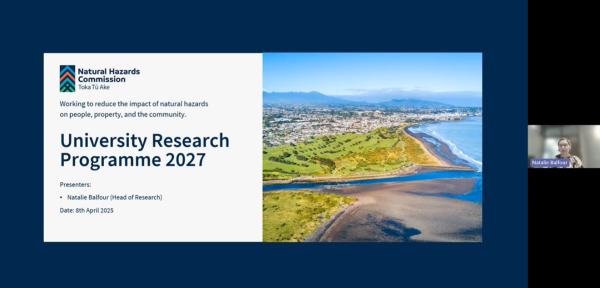
Read the transcript [TXT, 20 KB]
The session also included a Q&A portion (which is not included in the recording above).
URP 2027 information session FAQs - updated 9 April 2026 [PDF, 121 KB]
Information session
We held an information session on 8 April to go over the URP guidelines and requirements.
The session also included a Q&A portion (which is not included in the recording above).
Expert assessment panel members
Theme‑based panels of subject‑matter experts who assess and score eligible URP proposals.
Resilient Buildings
- Shannon Fraser (Chair), Natural Hazards Commission Toka Tū Ake
- Ghada Elashi, Natural Hazards Commission Toka Tū Ake
- Kaley Crawford-Flett, Consultant/University of Auckland
- Haukapuanui Vercoe, University of Auckland
- Faraz Zaidi, University of Auckland
- David Carridine, Building Research Association of New Zealand (BRANZ)
- Catalina Miranda, Joint Centre for Disaster Research, Massey University
Quantifying Hazards
- Sally Owen (Chair), Natural Hazards Commission Toka Tū Ake
- Maxim Millen, Tonkin + Taylor
- Darren King, Consultant
- Geoff Kilgour, Earth Sciences New Zealand
- Ali Davies, Natural Hazards Commission Toka Tū Ake
- Erin McEwan, Natural Hazards Commission Toka Tū Ake
Supporting People and Decisions
- Sally Owen (Chair), Natural Hazards Commission Toka Tū Ake
- Alex Cartwright, Natural Hazards Commission Toka Tū Ake
- Charlotte Brown, Resilient Organisations
- Sally Potter, Canary Innovation Ltd
- Robert Cardwell, Market Economics
- Belinda Storey, Climate Sigma
Smarter Land Use
- Delia Tamsen (Chair), Natural Hazards Commission Toka Tū Ake
- Tabitha Bushell, Natural Hazards Commission Toka Tū Ake
- James Beban, Urban Edge
- Tom Fitzgerald, Wellington Regional Leadership Committee
- Emily Grace, NZ Planning Institute
Research Advisory Committee Members
A committee of senior NHC representatives and external experts that provides strategic moderation and final funding advice.
- Natalie Balfour (Chair), Natural Hazards Commission Toka Tū Ake
- Richard Smith, Earth Sciences New Zealand
- Sean Fullan, Insurance Council of New Zealand
- Gill Jolly, Earth Sciences New Zealand / Ministry of Business, Innovation and Employment
- Alison Collins, Ministry for the Environment
- Emma Hudson-Doyle, Natural Hazards Commission Toka Tū Ake / Joint Centre for Disaster Research Massey University
- Karla Falloon, Building Research Association of New Zealand (BRANZ)
- Ken Elwood, Ministry of Business, Innovation and Employment / Natural Hazards Commission Toka Tū Ake / University of Auckland
- Tom Wilson, National Emergency Management Agency / University of Canterbury
URP projects 2024-2027
Nine University Research Programmes (URPs) were awarded in the latest round (2024-27). These programmes started on 1 January 2024 and end on 31 December 2026.
Sign up for updates
Email us if you have any questions or would like to join our research mailing list to receive updates on funding opportunities.