New research to help cut through crowdsourced "noise" after ashfall
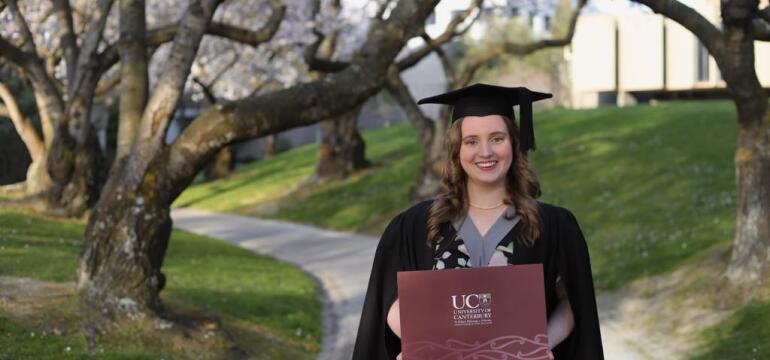
Niamh Barrington Stratton, master's student at University of Canterbury, helping cut through crowdsourced “noise” to improve damage estimates after ashfall.
Volcanic ash might look like dust, but it’s actually made of tiny, gritty fragments of rock and glass. When it falls on towns and cities it can irritate eyes and airways, contaminate water, and bring air and road traffic to a standstill.
Ash is also a big problem for homes and buildings. It builds up on roofs, clogs gutters and drains, and can get tracked or blown inside. When ash gets wet it becomes heavy, sometimes causing roofs and drains to collapse under the strain. Ash can also be abrasive and mildly corrosive, and it can damage heat pumps, air-conditioning units and other equipment.
Ashfall from an eruption could affect tens of thousands of buildings, so modelling is an important way to get early estimates of what might be damaged and where. The challenge is that the models we rely on are often based on limited overseas data, and they can’t easily be adjusted as real damage information comes in – which can leave early estimates highly uncertain.
That’s what Niamh Barrington Stratton, a Master of Science candidate at the University of Canterbury, is helping to address through a Natural Hazards Commission Toka Tū Ake-funded biennial grant project led by Dr Josh Hayes (Earth Sciences NZ).
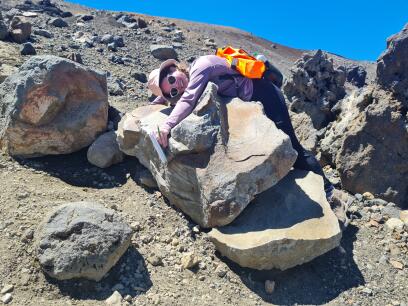 The wider project is working towards better, faster ways to estimate ash damage after an eruption by improving how models can be updated using real-world observations – from expert assessments to photos and satellite images.
Niamh’s piece of the puzzle focuses on a practical question: when different sources give different stories, how do we judge which information is most trustworthy?
She has developed a new framework to rate the reliability of building damage observations from volcanic ash, helping make rapid assessments clearer and more consistent.
Niamh’s talent has also been recognised with awards including the Rocket Lab Scholarship, and the S.J. Hastie Scholarship from the Geoscience Society of New Zealand.
Read on for Niamh’s Q&A, where she shares what drew her into natural hazards research and what she’s learning along the way.
What is your project, in a nutshell, and why is it important to New Zealand?
During a disaster, rapid impact assessments are needed to estimate the extent and intensity of resulting damage. Modelling is often conducted to obtain an understanding of the potential impact, but it can also be highly uncertain, as the underpinning models may not be well calibrated to the local context.
Therefore, impact observations are important to ground truth these models. Impact data can be obtained from diverse sources including expert surveys, satellite imagery, drone footage, media reports and social media. However, these data sources can vary in their reliability, and they may conflict with one another. Therefore, a framework for evaluating the reliability of these data sources is necessary.
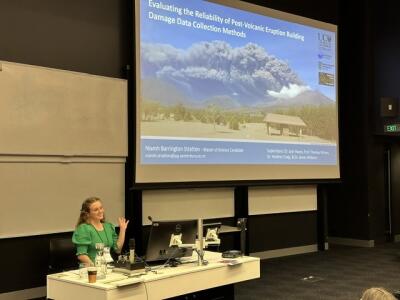 My Master of Science Thesis project has developed a new impact data reliability assessment framework. The framework evaluates impact data reliability based on a set of key attributes that are considered controls for impact data reliability.
One such attribute is the impact data quality; this includes considering the level of detail in written descriptions, the clarity and focus of photographic data and whether the information provided is quantitative or qualitative.
I focus on the application of this framework for building damage state classifications for volcanic ash to classify the reliability of damage observations for individual buildings. This application is extremely important here in New Zealand where there are several active volcanoes which can produce volcanic ash that may impact and cause damage to buildings in an eruption event.
This framework provides a mechanism for impact data to be robustly integrated into vulnerability models and rapidly and dynamically calibrate them to the local context, which improves impact model outputs.
What’s your favourite part of being a researcher?
I really enjoy the creative aspect of scientific research. While it’s not necessarily the first word, I’d use to describe scientific research I think it’s one of the more important ones.
 New scientific research demands fresh ideas and perspectives, and benefits from creative approaches and solutions. I enjoy the challenge of merging creative solutions with scientifically rigorous logic and methods.
Particularly with my Master’s research, I’ve had to be highly creative in the design of a new reliability assessment that evaluates the key attributes of data reliability while targeting the limitations of past studies.
In the inter-disciplinary space of natural hazard research, using creativity encourages flexible and dynamic solutions to challenges that will only evolve and I find it really exciting to be at the cutting edge of such research.
What sparked your interest in studying natural hazards?
Growing up in New Zealand I’ve experienced my fair share of natural hazards including earthquakes and severe weather.
When I got to university, after changing from a Physics major, I took a Geohazards paper and absolutely loved it. I really enjoyed learning about the scientific processes which cause natural hazards and the challenge of ensuring that this scientific knowledge is used to reduce the potential risk from such hazards through mitigation and other reduction strategies.
In my fourth year, I took a quantitative risk assessment course and knew I’d found my passion. My favourite part of researching natural hazards is at the intersection of the scientific research into their dynamic nature and quantitatively assessing the exposure and vulnerability of assets to them.
Why is it important to invest in natural hazards research like yours?
Successful rapid impact assessment frameworks are crucial to invest in as they bridge the gap between scientists and decision-makers in the response to disasters in both the short- and long-term.
Given the direction of technological advance and increased accessibility to the internet and media, I think we are going to see an increase in scientists using crowd-sourced information for rapid impact assessments out of necessity.
As a result, ensuring that we have transparent methods to communicate the reliability of such impact data will be vital, particularly when the application of that information relates to life safety.
Similarly, given the limitations of currently generalised models, I think investment into contextualised vulnerability models should increase because it is something that we can do pre-emptively to reduce the potential impact in the long-term, and I believe that is always worth investing in.
What’s one finding from your research that you want more people to know?
One such finding is that when a disaster occurs, affected communities can provide valuable insights on the extent and severity of the impacts produced. These insights can contribute vital local and indigenous knowledge which can help scientists better understand the context of the event. This is particularly important in events where accessibility is limited.
When shared publicly, this information can be used to develop more effective short- and long-term emergency responses. It also enables experts to assess impacts more accurately, rather than relying on preliminary models which are often highly uncertain.
What advice do you have for people who are interested in working with you, or in your field?
When you first enter into disaster, risk and resilience-based research it is going to feel like the most complex jigsaw puzzle you have ever seen. It’s one of those fields where understanding comes with continued exposure and experience.
With my background in physics and geology, the learning curve at the start of my thesis was intense. I spent a significant amount of time researching the terminology, processes and frameworks which guide this field.
However, as I have continued my thesis research I am definitely better placed to talk about my small speciality within this interdisciplinary field. So, my advice would be to keep going, even when it’s overwhelming it’s not an insurmountable knowledge bank to develop.