Science meets mātauranga Māori in breakthrough flood model
A breakthrough programme of research blending science and mātauranga Māori is helping an iwi in Blenheim understand not just how flooding will impact their land—but what it could mean for their culture, identity and connection to place.
The work, which combines advanced flood modelling with intergenerational lived experience, has been named a finalist in the New Zealand Science Awards, recognising its innovative approach to understanding both physical risk and cultural loss.
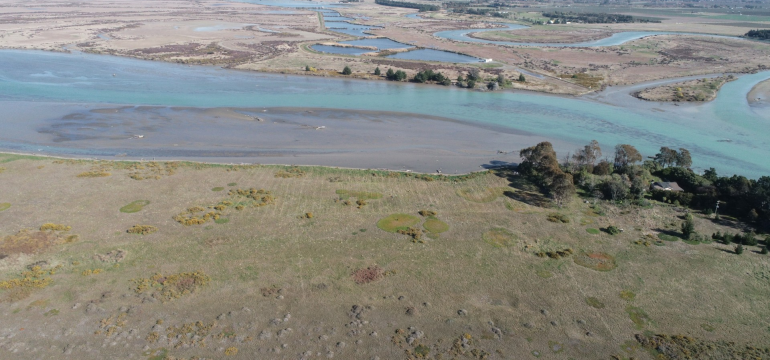
Developed for Te Pokohiwi o Kupe (Wairau Bar), where the Wairau River meets the sea, the model shows that up to 75% of the low-lying area could be impacted during a one-in-100-year storm by 2130 under projected sea level rise. The site is one of Aotearoa New Zealand’s earliest human settlements and holds deep cultural and archaeological significance, including wāhi tapu, urupā and ancestral remains.
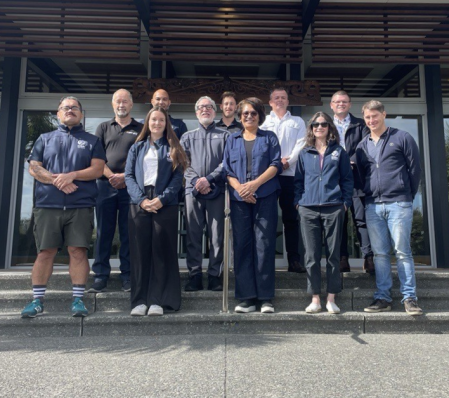
The Wairau project team.
Rangitāne o Wairau partnered with Earth Sciences New Zealand and Marlborough District Council to develop the flood model, before expanding the project to include mātauranga Māori through wānanga and interviews with kaumātua.
That second phase of the work was funded by Natural Hazards Commission Toka Tū Ake, enabling intergenerational knowledge of flooding and coastal change to be translated into indicators of cultural impact and incorporated into the model. Together, the two phases create a more complete picture of flood risk—one that reflects not just damage to land and property, but to culture and identity.
Rangitāne General Manager Corey Hebberd says recent extreme weather has brought future risks into sharp focus.
“The region has been hammered by so-called ‘one-in-100-year’ events since 2022. Flooding is accelerating coastal erosion and increasing the risk of exposing and washing away archaeological artefacts and ancestral remains,” he says.
While hazard models have traditionally focused on economic and environmental damage, this project goes further by capturing cultural impact in a structured, measurable way.
“Collectively, we’re good at modelling financial and economic loss, but that’s only part of the picture. For us, the real question is what happens to our identity, our history, and our connection to this place,” says Hebberd.
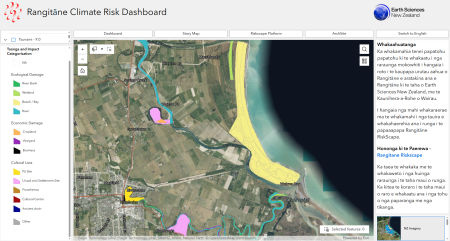
The hazard model dashboard.
Earth Sciences NZ project lead Dr Shaun Williams says the model links flood intensity to outcomes such as disruption to ancestral connections, impacts on urupā, and loss of mahinga kai.
“This is the first time in Aotearoa that we’ve been able to represent cultural loss in a hazard model in a meaningful, measurable way,” he says.
The result is a new type of decision-making tool that reflects what communities value most—going beyond dollars and infrastructure to include taonga, identity and wellbeing.
Rangitāne will use the model to guide the future management of Wairau Bar, following a new agreement with the Department of Conservation that recognises the iwi as the site’s administering body.
“It’s the first time in generations that we’ll have a meaningful say in how this land is managed,” says Hebberd. “This model makes future risks more tangible and gives us a stronger foundation for practical actions like erosion mitigation, planting and monitoring.”
The approach is already attracting national and international interest. Iwi in other regions are exploring how it could be applied to their own significant sites, while the National Emergency Management Agency has signalled interest in incorporating mātauranga Māori into broader hazard and risk frameworks.
Dr Natalie Balfour, Head of Research at Natural Hazards Commission Toka Tū Ake, says the project shows the value of research that supports communities facing increasing risk.
“This turns hazard science into something people can use right now to make real decisions about what to protect and prioritise,” she says.
“It also has strong potential to be adapted for other coastal communities in Aotearoa and across the Pacific.”
Williams says the model’s relevance extends beyond New Zealand.
“There’s strong alignment with challenges facing Pacific communities. It’s something we’re beginning to apply in places like Samoa, Tonga and Vanuatu.”
Hebberd says the project demonstrates what’s possible when different knowledge systems are brought together.
“This is about protecting cultural identity while also considering environmental and economic realities. It’s about finding a path forward that works for everyone.”